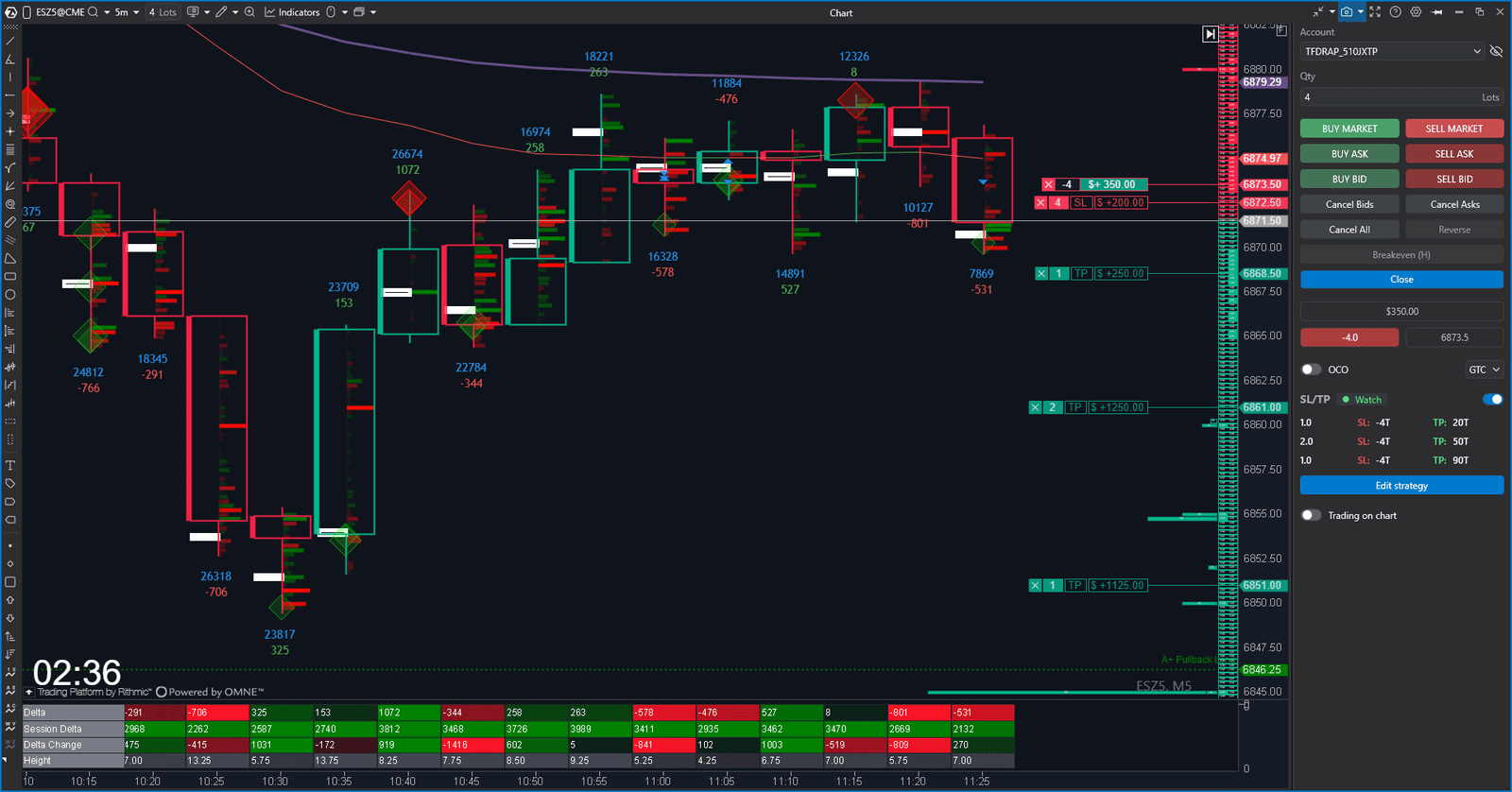
🚦Step 1: Spot Aggression
Footprint imbalance reveals who’s pressing the gas or slamming the brakes.
Clue: Large, one-sided trades — e.g., 80×0 or 100×0 — show aggressive sellers hitting the bid. Buyers aren’t stepping in.
RAIN Take: Confirms your expected direction for the Break + Retest setup.
Pro Tip: Watch multi-rotation trades; a single spike can be misleading.
🛑 Step 2: Detect Stop Runs & V-Reversals
Stop Runs: Triggered stops get filled with no counterparty. Footprint shows big trades with zeros on the opposite side.
V-Reversals: Immediate counter-aggression signals strong reversals.
Actionable: A sudden stop run followed by a V-Reversal often defines your next high-probability entry zone.
📊 Step 3: Volume vs Price
High volume + no price change: Absorption — liquidity defending a level.
High volume + price moves: Momentum ignition — gas pedal pinned.
Example Session: A breakout zone sees 8k contracts over 15 minutes but price doesn’t budge → heavy absorption, be patient for continuation.
🎯 Step 4: Mark Key Levels
High-volume interaction zones become pivot points:
Defended levels = liquidity clusters & stop zones.
Look for repeated interaction across rotations; these are ideal retest setups.
RAIN Tip: Break + Retest works best around these levels; acceleration on a breakout signals trend continuation.
🧭 Step 5: Expected vs Actual
Compare anticipated market behavior with what unfolds.
Multi-rotation absorption = hesitation or defense; immediate follow-through = conviction.
Rule of Thumb: Track where buyers/sellers repeatedly defend positions. It tells you where the real power lies.
⚙️ Step 6: Practical Checklist
Focus on interactions, not just candle shapes.
Distinguish high vs low volume — low volume can be algorithm noise.
Record pivot zones — defended by big players, not just one-off trades.
Combine RAIN + Smart + SR for higher-probability setups.
🧭 Step 5: Expected vs Actual
In conclusion, mastering FuturesFlow scalping involves adherence to the fundamental rules outlined above. By focusing on liquidity, implementing a robust risk management strategy, and utilizing technical analysis, traders can significantly enhance their chances of achieving consistent profits. As with any trading approach, continuous learning and adaptation are vital for success. Start applying these rules today and begin your journey towards successful scalping in futures trading.
TL;DR
Imbalance = Gas Pedal
Stop Runs = Sudden Acceleration
Absorption = Gas Off
V-Reversals = Immediate Counter-Move
Defended Zones = Pivot for Break + Retest
Master these, and you’ll see beyond price — knowing who’s really in control and where momentum is headed.